Peppermint essential oil (PEO) offers numerous benefits for health, skin, and hair, largely due to its main component, menthol, which provides a cooling sensation and has analgesic and anti-inflammatory properties.
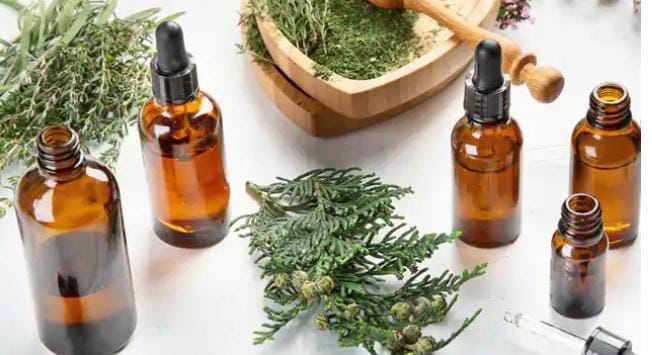
Essential oils are highly concentrated plant extracts that capture the plant’s scent and flavor. They are obtained by extracting volatile aromatic compounds from various plant parts, such as leaves, bark, flowers, or roots, using methods like steam distillation or cold pressing. Due to their potency, they should always be diluted and used with care.
Essential oils are very potent so it is crucial to always dilute them with a carrier oil to avoid skin irritation.
A standard dilution for general adult use is:
2-3%, while facial products often use a lower 1% dilution. Some products like rinse-off cleansers might use up to 3%, and specific acute conditions could require up to 10%, but for no more than a week at a time.
GENERAL DILUTION GUIDELINES FOR ADULTS.
For sensitive areas or sensitive skin: Use a 0.5-1% dilution (3-6 drops of essential oil per 1 ounce of carrier oil).
For general adult use (massage oils, lotions): Use a 2-3% dilution (12-18 drops per 1 ounce of carrier oil).
For acute conditions (infections, short-term use): A 5-10% dilution may be used, but not for more than a week at a time.
For one-time applications (wounds, scrapes): A 25% dilution can be used for a single application only.
DILUTION FOR CHILDREN AND INFANTS
Children (6-12 years): Use a 0.5-1% dilution.
Infants (under 6 years): Use a 0.25% dilution, or 1 drop per ounce of carrier oil.
USAGE RATE IN SPECIFIC PRODUCTS
Facial skincare: 1% dilution is a common starting point.
Body oils and lotions: 1-3% dilution is a common range, with 2% being frequently used for leave-on products.
Bath and shower products (rinse-off): A 3% dilution is often recommended.
Soap making: A common starting point is 3% of the total base oil weight.
IMPORTANT CONSIDERATION
Always dilute: Never apply undiluted essential oils directly to the skin.
Perform a patch test: It is always wise to test a small amount of the diluted oil on a small area of skin first to check for any reaction.